
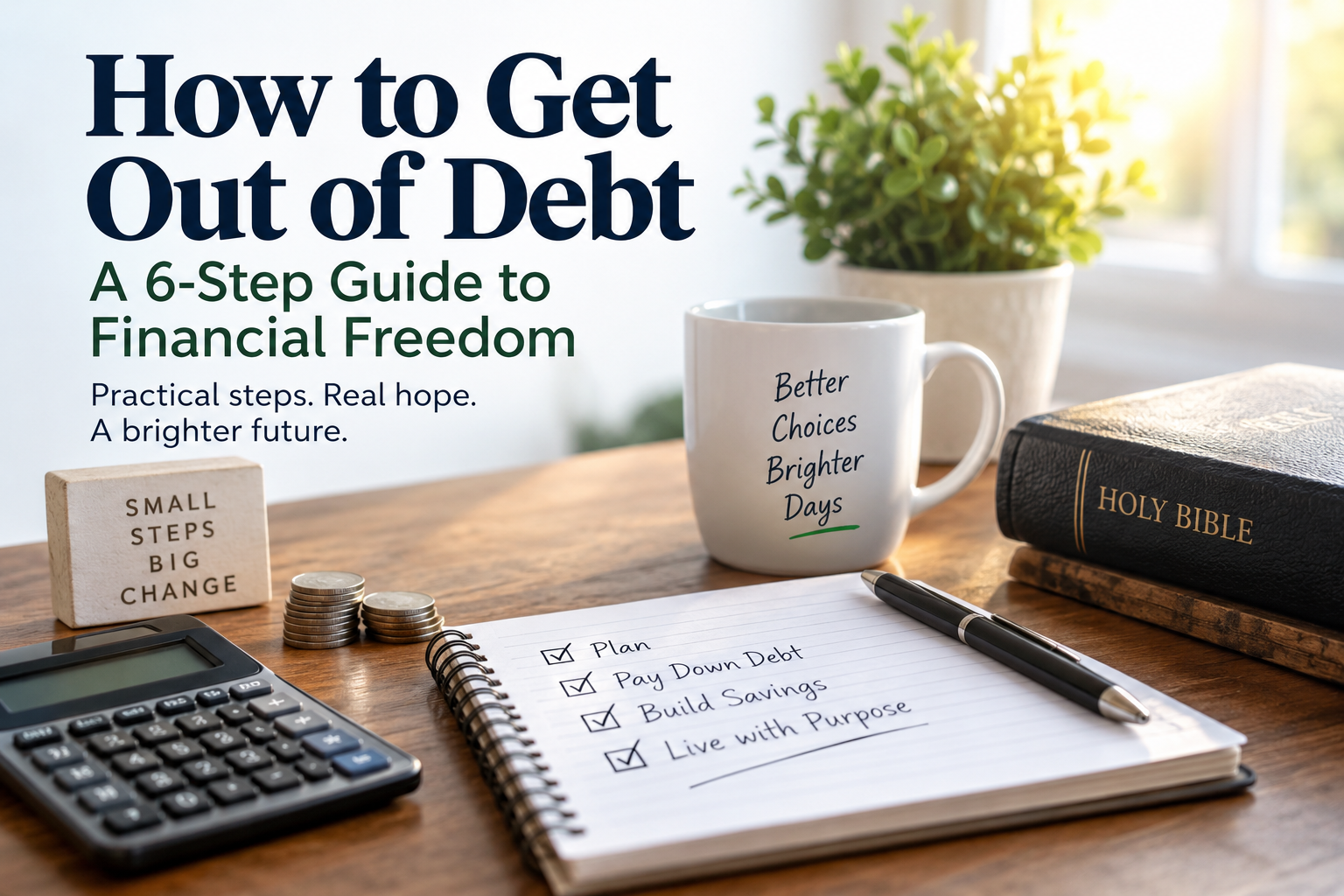
How to get out of debt? Millions of people ask this question every day because they feel overwhelmed by their financial situation. Bills keep arriving, interest keeps growing, and every paycheck can seem to disappear before they make any progress.
You might be juggling credit cards, personal loans, medical bills, or overdue payments and wondering where to begin. If that sounds familiar, getting out of debt starts with one manageable decision: face the numbers and make a plan you can follow.
There is no instant fix, but financial freedom does not have to remain a distant dream. You can begin by listing what you owe, protecting essential expenses, creating a realistic budget, and choosing a debt repayment method that fits your circumstances.
Small, consistent payments and sensible spending changes can add up over time. If you cannot afford minimum payments, getting help early is more important than trying to solve everything alone.
For Christians, this journey also involves faithful stewardship. Proverbs 22:7 reminds us that borrowing creates obligations, while Proverbs 21:5 points to the value of diligent planning. These principles are meant to guide wise choices, not to shame anyone facing hardship. Debt can arise from illness, unemployment, family emergencies, and other circumstances beyond our control.
In this practical guide, you will learn how to get out of debt step by step: assess your balances, build a workable budget, compare the debt snowball and avalanche methods, establish a small emergency cushion, avoid debt-relief scams, and find trustworthy support when needed. The goal is steady progress toward less financial stress, greater stability, and the freedom to use your resources wisely.
Debt can come from medical bills, unemployment, or unexpected hardship, so this guide emphasizes practical steps over shame.
Table of Contents
How to Get Out of Debt in 6 Steps.
Getting out of debt starts with a clear picture of what you owe and a repayment plan you can sustain. Here are six practical steps to begin:
- List your debts. Record each balance, interest rate, and minimum payment.
- Create a realistic budget. Cover essentials and identify what you can afford to put toward repayment.
- Choose a repayment strategy. Compare the debt snowball and debt avalanche methods.
- Build a small emergency fund. Set aside what you can to reduce reliance on new borrowing.
- Ask for help when needed. Contact creditors early, explore reputable counseling, and avoid debt-relief scams.
- Build lasting money habits. Review your progress monthly and plan to prevent debt from returning.
The sections below explain each step with practical examples and biblical insights.
What Does the Bible Teach About Debt?
Proverbs 22:7 describes the borrower as servant to the lender. This warns about the obligations and reduced choices borrowing can create, not that every loan is sinful.
Proverbs 21:5 commends diligent planning, while Psalm 37:21 calls attention to honoring what we owe.
Luke 14:28 uses the image of calculating the cost of building a tower to teach about discipleship; it also offers a memorable illustration of why commitments deserve thought before we make them.
Scripture should never be used to shame a family whose debts arose from illness, unemployment, disability, or caring for others.
Practical application: Ask God for wisdom (James 1:5), then gather actual financial records. Prayer and practical planning belong together.
A clear list of obligations allows you to make responsible decisions instead of relying on fear or guesswork.
Step 1: How to Get Out of Debt by Understanding What You Owe
Debt repayment starts with knowing exactly what you owe. Collect current statements for every credit card, personal loan, student loan, auto loan, medical bill, buy-now-pay-later plan, and money borrowed from relatives.
Record the lender, balance, annual percentage rate, minimum payment, due date, and whether the account is current.
A smaller balance can have a higher interest rate than a larger loan, so you need both figures to decide.
For example, suppose a household owes $300 on a medical bill, $900 on a credit card, and $2,000 on a loan. Its starting debt is $3,200 before future interest and fees.
Write the amounts in a notebook or spreadsheet and update them monthly. If an unfamiliar collector contacts you, verify the debt before providing payment information. Keep correspondence in a secure place.
Action step: Set aside 30 minutes to gather statements. Highlight overdue accounts and those with unusually high interest.
This inventory is a decision-making tool, not a judgment about your character.
Start With Your Numbers.
Before selecting a repayment strategy, make a complete debt inventory. Collect current statements for credit cards, personal loans, car loans, student loans, medical bills, and buy-now-pay-later purchases.
Record the balance, interest rate, minimum payment, due date, and whether the account is overdue. Keep this information secure.
For example, a household with a $300 medical bill, a $900 credit card balance, and a $2,000 personal loan owes $3,200 before future charges. Seeing that number may feel uncomfortable, but it provides a useful starting point.
Next, calculate take-home income rather than gross salary. Review the last three months of transactions to identify realistic spending on groceries, transportation, and household needs.
A budget built on guesses often fails because its assumptions were wrong, not because the person lacked discipline. If you expected to spend $250 on groceries but your actual average is $370, start with $370 and look for achievable savings.
Action step: Write down every debt and bill. Mark high-interest accounts and any urgent missed payments. When possible, contact creditors before you miss a payment.
If a debt collector contacts you unexpectedly, verify the debt and understand your rights before paying.
List each creditor, balance, interest rate, minimum payment, and due date. Calculate take-home income, then protect housing, food, utilities, essential health costs, and transportation before choosing extra repayment.
If you earn $2,500 monthly and essentials cost $2,250, only $250 remains for savings, optional spending, and additional payments.
Step 2: How to Get Out of Debt With a Realistic Budget
Separate expenses into four groups: essentials, required debt payments, irregular bills, and flexible spending.
Essentials include housing, food, utilities, necessary transportation, and medical needs. Irregular bills include car repairs, insurance renewals, and school expenses.
A $600 annual insurance premium requires setting aside $50 a month; ignoring it turns a predictable bill into an emergency.
Example: A household takes home $3,000. Housing costs $1,050, groceries $450, transportation $300, utilities and phone $250, health and insurance $250, minimum debt payments $250, and other essentials $150.
That totals $2,700, leaving $300. They allocate $100 to emergency savings, $150 to extra debt payments, and $50 to flexible spending.
The amounts are illustrative, not universal percentages. If essential costs exceed income, you may need assistance or additional resources; cutting small pleasures cannot always solve a large shortfall.
Action: Review the previous two or three months of bank statements and adjust estimates to reflect actual spending. Your first budget should be realistic, not impressive.
Use the Debt Snowball.
The debt snowball focuses extra payments on the smallest balance first while maintaining required minimums on all other accounts.
Imagine a $300 medical bill with a $25 minimum, a $900 card with a $40 minimum, and a $2,000 loan with a $75 minimum. You find $100 extra each month. Pay $125 toward the medical bill while continuing the $40 and $75 minimums.
After the medical bill is cleared, redirect the $125 toward the card, making its payment $165. Once the card is gone, redirect that $165 toward the loan, making its payment $240. The example ignores interest and fees; real payoff dates will vary.
Why do some people prefer this method? Early victories can build confidence. A person overwhelmed by five separate bills may find it encouraging to eliminate one account.
However, snowball payments can cost more interest if a high-rate debt remains outstanding. Understand that tradeoff before choosing a method.
Imagine a $300 bill with a $25 minimum, a $900 card with a $40 minimum, and a $2,000 loan with a $75 minimum. With $100 extra monthly, pay $125 toward the smallest debt while continuing the other minimums.
When it is cleared, pay $165 toward the next debt; finally, pay $240 toward the loan. Actual payoff dates depend on interest and fees.
Compare the Debt Avalanche.
The debt avalanche targets the highest interest rate first, not necessarily the smallest balance. Suppose a credit card charges 27 percent APR and a personal loan charges 8 percent APR.
Extra payments to the card generally save more interest than extra payments to the lower-rate loan, assuming you continue making minimum payments and don’t take on new debt.
Compare the repayment orders using your actual balances, rates, and monthly amounts. Watch for expiring promotional rates, variable rates, and prepayment fees.
The avalanche may be mathematically efficient while the snowball provides more immediate emotional rewards. Neither is automatically right for everyone.
A plan that lasts twelve months is better than an ambitious schedule abandoned after two weeks. Whichever method you choose, do not skip rent, groceries, medicine, or minimum payments to accelerate one balance.
Practical exercise: Make two lists of your debts: one ordered by balance, one by interest rate. Identify the first account under each strategy.
Discuss the likely interest savings and which method would help you stay consistent. If your debt has become unmanageable, ask a reputable nonprofit credit counselor about options before committing to an expensive program.
The avalanche method targets the highest-interest balance first while maintaining minimums elsewhere. It generally saves more interest, while the snowball can provide motivating early wins.
Choose Between Snowball and Avalanche.
Debt snowball prioritizes the smallest balance, creating early motivational wins. Debt avalanche prioritizes the highest annual percentage rate, generally reducing interest costs when you pay all minimums and add no new debt.
Suppose a credit card charges 27% APR while a personal loan charges 8% APR. Directing extra money to the card usually saves more interest, even if the loan balance is smaller.
The snowball may be easier to sustain for someone motivated by eliminating an account quickly. Neither strategy replaces paying required minimums or covering essential living expenses.
Action: Write your debts in two orders—smallest balance first and highest interest first.
Compare the likely interest costs and the motivation you need. Review promotional rates, fees, and repayment terms before choosing.
Build Emergency Savings.
Proverbs 21:20 commends the wisdom of keeping resources in reserve. Without a cash cushion, an unexpected car repair or urgent medical expense may send you back to a high-interest card.
Begin with an attainable goal, perhaps $250 or $500, based on your circumstances. Saving $5 weekly yields $260 in a year, $10 weekly yields $520, and $15 weekly yields $780, before interest.
Keep the money accessible and separate from everyday spending. Avoid automatic transfers that would cause overdraft fees.
Distinguish emergencies from predictable irregular expenses. A $600 annual insurance bill is not a surprise; set aside $50 monthly for it. If school expenses total $480 each year, reserve $40 a month.
These savings categories are sometimes called sinking funds. Building them prevents ordinary calendar events from becoming new debts.
The right balance between savings and extra debt payments depends on your job security, interest rates, health needs, and household risks. Don’t force one percentage on every family.
Even $10 saved weekly becomes $520 over 52 weeks before interest. Keep a small emergency cushion and plan separately for annual bills.
Seek Help Early.
If a payment may be late, contact the lender promptly. Ask whether hardship arrangements, changed due dates, temporary reduced payments, or fee waivers are available.
Find out whether interest continues, how credit reporting is affected, and when regular payments resume—request written confirmation. Keep a record of the date, representative’s name, and agreed terms.
For medical debt, request an itemized bill, check whether insurance processed the claim correctly, and ask about hospital financial-assistance policies.
If a collector contacts you, verify the obligation and learn your rights before sharing sensitive financial details. Do not ignore a court summons; seek qualified legal advice quickly.
Some households face a genuine income shortage. If take-home pay is $2,100 and essential costs are $2,450, you can’t fix the $350 monthly gap by rearranging payments.
Prioritize immediate needs, explore food and utility assistance, check benefits eligibility, and consider safe additional income where possible.
Churches and community organizations may provide practical help. Asking for assistance is compatible with responsible stewardship.
Contact creditors before missed payments, ask medical providers about financial assistance, and beware of companies promising guaranteed debt elimination.
The Consumer Financial Protection Bureau and Federal Trade Commission provide educational resources and scam warnings.
Recognize Debt-Relief Scams.
Be wary of companies promising guaranteed debt elimination, immediate credit-score repair, or secret government programs.
High upfront fees, pressure to stop paying creditors, and demands for passwords are warning signs. Debt settlement can damage credit, trigger collection activity or lawsuits, and sometimes create tax consequences. It is different from nonprofit credit counseling and debt-management plans.
Before signing any agreement, ask for the total fees, expected timeline, risks, and what happens if you cannot complete the program.
Check the organization’s reputation and read the contract carefully. The Federal Trade Commission publishes consumer scam warnings, while the Consumer Financial Protection Bureau provides educational resources. For legal action or possible bankruptcy, consult a qualified attorney.
There is no shame in exploring legal debt relief when repayment is impossible. The goal is to understand your choices, not follow a salesperson’s promise. A credible adviser will explain tradeoffs and costs instead of guaranteeing a miracle.
Be cautious of companies that promise guaranteed debt elimination, demand large upfront fees, or tell you to stop communicating with creditors.
Debt settlement may harm credit, trigger collections or lawsuits, and have tax consequences. Nonprofit credit counseling can help you evaluate options, but verify an organization’s reputation, costs, and terms.
For serious financial distress or legal notices, consult a qualified attorney. The Consumer Financial Protection Bureau and the Federal Trade Commission provide official guidance.
What If You Cannot Afford Minimum Payments?
Start by protecting housing, food, necessary utilities, essential transportation, and medicine. When possible, call lenders and service providers before missing payments.
Explain what changed and what you can realistically afford. Do not agree to a hardship payment that leaves your family unable to buy groceries. If bills exceed income even after reasonable adjustments, explore community assistance, benefits, and professional guidance.
Consider a worker whose hours were cut. Monthly income falls from $2,800 to $2,100, while rent, utilities, food, transportation, and essential care total $2,450.
The problem is a $350 shortfall before optional purchases. Canceling a $15 subscription helps only slightly. The household may need rental or utility assistance, a creditor hardship arrangement, additional safe Work, or help from family and community organizations. Treating this as a moral failure would obscure the real problem.
Debt decisions can affect other household members. If you share finances with a spouse or partner, schedule a calm, blame-free discussion about bills and priorities.
Where financial control or abuse is present, seek specialized support and prioritize safety rather than insisting on joint budgeting.
When possible, contact creditors before the due date and ask about hardship programs, fee waivers, or payment arrangements. Request terms in writing and ask whether interest continues. For medical debt, request an itemized bill, check insurance processing, and ask about financial assistance.
Protect immediate needs such as housing, food, essential utilities, transportation, and necessary medicine. A household with $2,100 income and $2,450 in essential costs has a $350 gap that no debt-payoff trick can fix. Explore assistance programs, safe additional income, and professional counseling without shame.
Seven-Day Debt Freedom Action Plan.
- Day one: Gather statements and pray for wisdom (James 1:5).
- Day two: List balances, interest rates, minimums, and due dates.
- Day three: Calculate take-home income and essential expenses.
- Day four: Identify one realistic savings opportunity or assistance resource.
- Day five: Compare snowball and avalanche payoff orders.
- Day six: Contact creditors about any unaffordable payments.
- Day seven: Schedule your monthly debt review.
Common Questions About Getting Out of Debt.
Is borrowing always a sin?
The Bible warns about debt obligations and encourages honesty and prudence, but does not declare every loan sinful. Evaluate the purpose, cost, and ability to repay.
Should I save or pay debt first?
Consider interest rates, income stability, emergency risks, and household needs. A modest cash reserve may prevent further borrowing.
Can I give while repaying debt?
Second Corinthians 9:7 emphasizes willing generosity. Giving can include time and service; do not neglect essential family needs or borrow under pressure.
How long will repayment take?
That depends on balances, rates, payment amounts, and new charges. Avoid guaranteed timelines and review actual progress monthly.
Trusted Sources and Further Reading.
For consumer education and debt resources, see the Consumer Financial Protection Bureau, Federal Trade Commission Consumer Advice, and USA.gov debt information. Review current rules and eligibility directly with the relevant provider.
How to Keep Debt From Returning.
Becoming debt-free is an important achievement, but keeping that progress requires a plan for future spending. Start by identifying what created the original balances.
Did irregular bills, lost income, medical needs, or spending that gradually exceeded earnings cause them? The answer matters because each cause requires a different prevention strategy.
A household with frequent car repairs may need a transportation savings fund, while a worker with unpredictable hours may need a larger cash buffer during stronger months.
Consider setting a rule for major purchases: wait at least one day, compare the full price, and check whether the purchase would reduce money reserved for essential bills.
For loans, calculate the total cost including interest and fees rather than looking only at the monthly payment. Review automatic renewals and subscriptions several times a year.
Keep a list of annual expenses so they do not arrive as surprises. If you use a credit card, understand the due date and the consequences of carrying a balance. Credit can be a tool, but you should not treat it as income.
Once you pay off one debt, decide in advance where the freed payment will go. It might accelerate another debt, strengthen emergency savings, or support an essential household goal.
Without a decision, that money can disappear into unplanned spending. Track your progress monthly, not obsessively every hour. Financial habits improve through steady practice.
How to Discuss Debt Without Shame.
Financial stress can strain marriages, friendships, and family relationships. Begin conversations with accurate numbers and a shared goal instead of accusations.
Say, for example, “Our payments are taking $350 each month; how can we make this more manageable?” rather than blaming someone for every purchase.
If a family member lent you money, communicate honestly about what you can repay and when. Do not make promises based on income you have not received.
For couples, a short monthly money meeting can cover income, upcoming bills, debt balances, and one achievable goal. Both partners should understand the main obligations, even when only one person maintains the spreadsheet.
Children can learn simple lessons about saving, needs, and wants without being burdened with adult financial fears. Where coercion or financial abuse is involved, prioritize safety and seek specialized assistance rather than forcing a joint conversation.
Christians can also seek encouragement from trusted community members while respecting privacy. Practical support might include transportation, meals, job leads, or help understanding paperwork. Such support is not a substitute for qualified legal or financial guidance, but it can make a difficult season less isolating.
Monthly Debt Review Checklist.
At the end of each month, compare beginning balances with ending balances. Record how much went toward principal and how much went toward interest or fees. Confirm that required payments cleared.
Review whether any new charges appeared. Check your emergency savings and upcoming irregular bills. If the plan did not work, ask what changed: income, essential expenses, interest rates, or unexpected events. Adjust the next month instead of abandoning the whole strategy.
Finally, measure progress in more than one way. A smaller total balance matters, but so do fewer missed payments, better awareness of bills, improved communication, and a growing emergency reserve.
Proverbs 21:5 points toward diligence rather than haste. Lasting financial change often comes from ordinary decisions repeated faithfully over time.
Next Steps.
Review your debt inventory monthly, avoid unnecessary new borrowing, and adjust the plan when income changes. James 1:5 encourages you to ask God for wisdom.